Has anyone else waited for the 2026 Edelman Trust Barometer annual report like a child waiting for Santa Claus? That was me earlier this week, when the report was launched Tuesday morning in Davos, Switzerland.
In a way, we all know it: trust is going down across the board. But when data speaks, the reality becomes much starker.
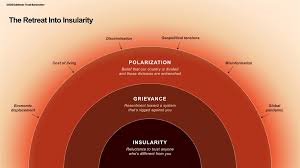
From the Barometer’s key theme of trust in crisis in 2017 to the battle for truth in 2018, we went on to discover the cycle of distrust in 2022, deep polarization in 2023, and the crisis of grievance in 2025. Now, in 2026, here we are, landing in the new reality of frightening insularity.
WHAT IS INSULARITY?
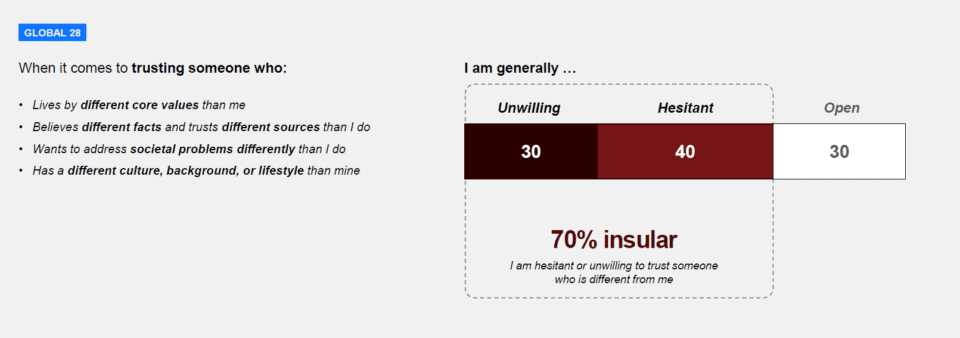
According to the Edelman Trust Barometer, 70% of people are generally unwilling or hesitant to trust someone who lives by different core values, believes different facts, has a different culture, background, or lifestyle, and trusts different sources of information than they do.
Only 30% of the 33,938 respondents in 28 countries feature an open mindset in relation to trusting others who look, behave, believe, and approach the world differently than themselves.
Source: 2026 Edelman Trust Barometer
People’s retreat into insularity is powered by several factors:
- Income divide: People on the lower income spectrum trust less than those in the higher brackets. The highest trust gap according to income level is present in the United States.
- Generalized fear and inflammatory political rhetoric.
- Generalized fear that the next generation will be worse off than our own generation (68%).
- Trade and recession-related job fears, and
- Fears of being left behind in the AI race.
All these concerns cause people to look inwards and to seek the comfort of their proximity: family and friends, small communities, employers, and companies with headquarters based in their own countries.
WHAT DOES INSULARITY MEAN FOR BUSINESS?
For CEOs stepping into 2026, this global picture of overwhelming insularity means several things:
- Your people hold more fear than you might be willing to admit. Once you understand and accept this, it means that you are ready to take full responsibility for the fact that you need to double down on transparency, better communications, and building more psychological safety for your people.
- Your people seek comfort in their relationship with your company. Employers are one of the few sources of trust that people still hold in high regard in 2026. Tread carefully – this can be a major opportunity for you and your business.
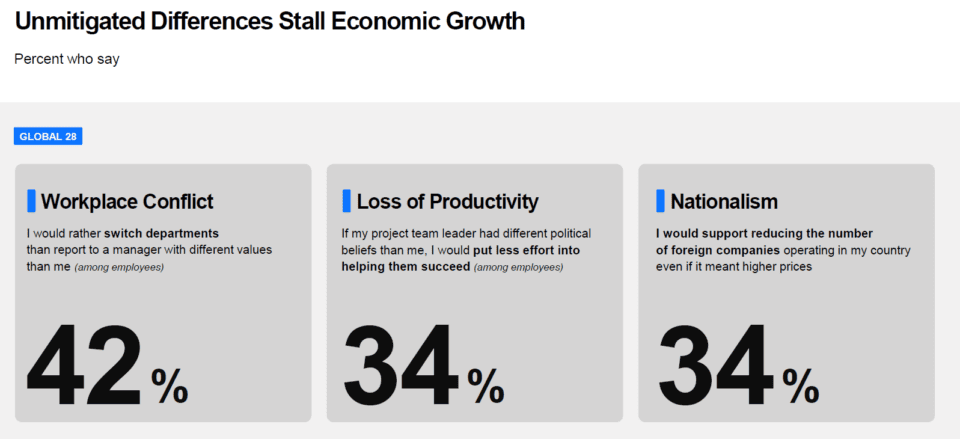
- Not addressing people’s fears and generalized insularity stifles innovation. The data speaks clearly: 42% of people would rather switch departments than report to a manager with different values than theirs, and 34% would put less effort into helping their managers succeed if their project team leader had a different political belief than themselves. In other words: do you hold different beliefs than me and I still have to work for you? Ok – I will drag my feet to work and do the bare minimum, but nothing more. And please don’t expect motivation, engagement, and enthusiasm from me – these are not fruits that grow on the acid soil of fear and distrust.
Source: 2026 Edelman Trust Barometer
To sum it up, what this new reality means for you, the CEO, is that your capacity to innovate and drive lasting transformation is directly proportional to your capacity to listen, take your people seriously, include them in high-stakes conversations and decision-making, communicate better, and drive more comfort, safety, and trust across your organization.
THE NEW CEO ROLE: TRUST BROKER-IN-CHIEF
Fortunately, the 2026 Edelman Trust Barometer didn’t stop at pointing to the challenges our world is facing. The report also provided some ideas and practical solutions to the crisis of insularity.
One of the key solutions to our broken trust is that any responsible senior leader needs to become a genuine trust broker across their complex business ecosystems.
If trust is the key to innovation and lasting transformation, building more trust among people is thus becoming a top business and leadership imperative.
And how can you become a trust broker so you can drive more trust and secure your chances of leading a company with a future?
- Listen more. Truly and genuinely listen more. Listening is a major challenge for leaders with power-grabbing tendencies emboldened by the recent narratives in global politics and the AI race, or for leaders with exhausted nervous systems who might have become a bit too emotionally reactive for their own good.
- Show up. Communicate better and involve your people in high-stakes conversations and decision-making.
- Facilitate dialogue. Proactively and courageously bring together people with different worldviews and facilitate healthy conversations among them.
- Provide a vision of unity. Focus more on what we have in common and what we are striving to achieve together rather than our granular differences.
To this recipe I would add one more ingredient: cutting down on all war-mongering rhetoric and focusing more on genuine collaboration, co-creation, respect, and lasting human values in the workplace.
WHAT THE REPORT DIDN’T COVER ENOUGH, IN MY VIEW
For all its great qualities, here is where I feel the report fell short:
- None of the countries in the report are located in Central, Eastern, Southern Europe. And yet, this region is now the center of economic growth in Europe. Could it be that the level of mistrust in our region might throw the global data even lower? We don’t know – until we have more data on this fact.
- The report didn’t include or emphasize the role social media plays concretely in the level of polarization, grievance, and insularity in our world. This is not ok. We truly need to start addressing the toxic side effects of our new social media algorithmic reality, its impact on our intellect, attention deficit, and mental health, and we need to make sure we both regulate social media providers AND protect people against disinformation and misinformation. Right now, we are still not taking this threat seriously.
- The report didn’t touch the presence of psychopathy in top leadership ranks. We need a psychological test to drive a car, but we don’t test our future political and corporate leaders rigorously and transparency on their psychological makeup. This is not ok. With a key feature of psychopathy being the lack of fear or using fear as a dominance tool, can we be surprised that our world is drowning in fear while a few people at the top take full advantage of the new reality? What’s worse – for the first time in history, these people now have weapons of global dominance such as social media and AI?
In our world, the new oil is not electricity. It’s not even data. It’s access to our brains. Being able to flip the switch of fear on at an individual level is the sweet dream of any dictator. We each have a role to play in this new reality – either by managing our own insularity, or by helping those around us manage theirs.
Perhaps this way we gain a fighting chance in this strange explosive new world that is opening its gates to us as we enter 2026.
LET’S TALK
🏆 Did you like this post? Send me an email and let me know: cristina.muntean@vornica.com
📲 Do you want to succeed in your new leadership role? Drop me a message via WhatsApp and let’s talk: +420 776 574 574
📞 Are you ready to discuss your unique path to new CEO success? Book a direct call with me and let’s talk: https://calendly.com/cristinamuntean/the-new-ceo-success-shared-vision-call.
💡Would you like more unique CEO insights and how-to advice? Follow me on LinkedIn: My newsletter The CEO Elevator® and my personal posts.