
Last week, I wrote about the eye-opening results of the latest PwC CEO Survey 2026, which showed skyrocketing optimism among Czech companies’ top leaders – a 26% jump in optimism from 36% in 2025 to 62% this year. Czech CEOs’ positive attitude is grounded in the relative health of the local economy, monetary stability, low inflation and low expectations from the current government, and a huge appetite to pursue acquisitions (M&A) in Czechia and abroad.
There is one area though that is not such solid ground for optimism, but which was delicately brushed aside during the report launch. However, the topic burst naturally during informal conversations over dinner and wine: how ready local CEOs truly are to embrace AI at full speed.
This article is therefore inspired both by these informal conversations AND by my executive development work with CEOs across Europe and Central Asia.
Without naming names, I will try to summarize my general observations and provide guidance on how CEOs could try to stretch their mindset to embrace AI – personally and in their organizations.
HERE IS THE REAL RISK WE DON’T TALK ABOUT – YET
I strongly believe that, unless a global event happens that will put the AI race to rest for a while, and if AI development continues at the massive speed of last year and this year, companies that don’t fully embrace AI now to reinvent their business models won’t be on the market in 7 to 10 years from now.
Yes, it’s that dramatic.
And that serious.
While deeply focused on being good custodians for their companies and industries, CEOs often fail to notice how fast clients’ mindset is changing.
Recently, two of my clients were appointed to lead the retail arms of two international banks.
Pure coincidence, and the reason to have a similar conversation with both of them.
Here is what we concluded: AI brings users the impression of empathy on steroids.
Impression and generalized delusion?
Sure, yes, absolutely.
This is the same pattern used by social media to give us the delusion of social connection while making us lonelier in real life.
But – and here is the big but – if clients are constantly flattered, cuddled, encouraged, and fawned over by AI, clients learn to expect the same degree of personalization, flattery, and emotional availability and adaptation they receive from ChatGPT / Claude / Gemini – you name it – from everyone selling anything to them.
This, friends, is the real risk.
When a client gets used to being constantly flattered and fawned over, when the client learns to feel egocentric – that they are the very center of the universe for someone, albeit an AI tool – they will embrace this emotional footprint and bring it to you during your next sales and client conversation.
And guess where you have the greatest vulnerability in your business right now because you never took this topic seriously?
In the emotional intelligence of your organizational system.
Are your client-facing people truly empathetic and emotionally adaptable?
Maybe a handful in customer care, but those are the first to burn out and change jobs unless the system allows them to mentally and emotionally regenerate.
Are your processes and systems set up with deep client empathy embedded in their daily flow?
Maybe, there where you used intelligent process design thinking. But when was the last time you took the pulse of ALL of your processes to check them for human-centricity?
Are your products and services crafted to flatter, impress, and celebrate the human client?
Are you sure?
Or do you still hope that compulsory legal requirements, monopoly, and good enough because there is nothing else will save your skin when the rubber meets the road?
This, friends – this quick shift in clients’ mindset AND emotional expectations from product and service suppliers triggered by AI is, in my view, the real risk run by every organization today, everywhere around the globe.
Cumulatively combine this risk with the speed of entry into new markets, services, and product design also powered by AI and you will get a better grasp of the real dimension of your company and business model vulnerability as we step into 2026 at full speed.
SO, WHAT CAN CEOS DO TO ALLEVIATE THIS MASSIVE SYSTEMIC RISK?
Here are a few ideas I share with my CEO clients, new or long-established in their roles. Now it’s time to share these ideas with you as well.
- Talk to your clients. For God’s sake, stop believing that client talk should be reduced to a handful of your sales and client management people. Get down from your white horse and get your hands dirty in multiple conversations. Your mind will be blown wide open by the reality check and by the subtle strategic insights your clients will share with you. Honestly, the future of your business lies in the quality of these subtle client insights. If you don’t catch them on time, or if you choose to receive them, safely pre-digested by your sales directors, you risk losing something vital: your own capacity to envisage the future of your business through the eyes of those who pay for it tomorrow: your clients.
- Use AI for strategic thinking. When they engage in AI usage, most CEOs still use AI like civilians – to improve their personal productivity, to write and proofread emails, to keep track of their health and well-being, or to do a bit of research before vital calls. Choosing to limit your AI mindset to only this type of behavior means using 0.0000001% of what AI can do for a CEO. The most important aspect of using AI strategically is to turn it into insightful strategic assistants that will blow your mind wide open. Craft strategy-focused AI assistants that are meant to talk to you, challenge you, envisage possible scenarios for your company, market competition, industry, and economy. Use AI as the most challenging mentor you’ve ever had – to pull at your brain, take your perception apart, and expand your thinking beyond anything possible. If you fail to do this, you miss the opportunity that AI gives you to truly amplify your CEO-level thinking. In other words, when used well, AI can turn your leadership brain into a god. Don’t say no to this once-in-a-lifetime opportunity.
- Don’t believe everything AI mirrors back to you. The risk of allowing AI to turn your brain into a god is that you might start believing this yourself. And God knows we don’t need more ego and god-like behaviors in the C-Suite 😊. The same way AI fawns over anyone, it will fawn over you as well. But beware – you, the CEO, will be more prone to jump on it because you are more used to people fawning over you because of your position, power, and access to resources. So, the more AI fawns over you, the more you need to stay humble, sober, and properly grounded. Second, don’t take AI advice at face value. Take the inspiration, but allow your own human, intelligent, systemically smart brain to double check reality and to draw its own conclusions.
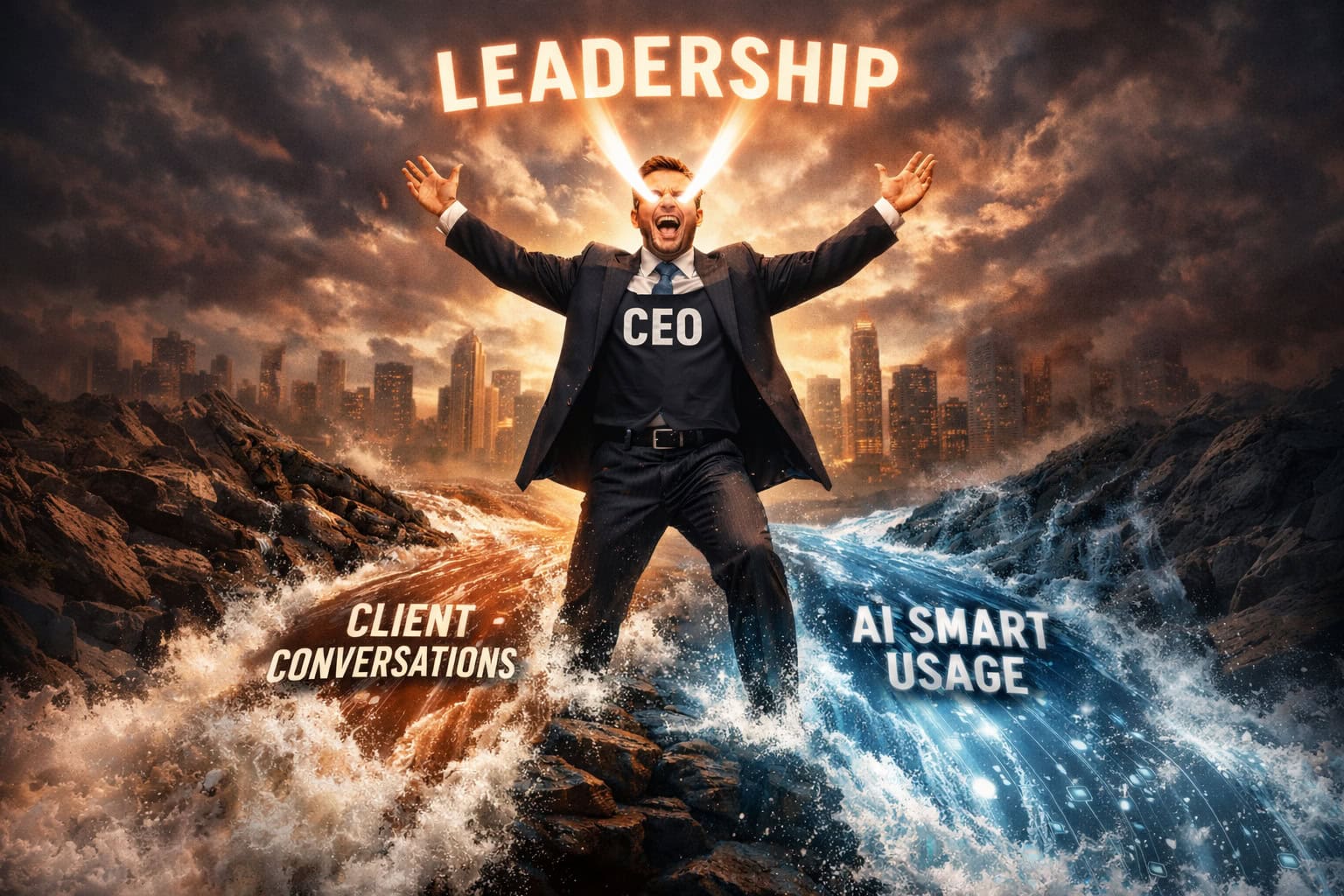
Essentially, I believe deeply that the companies whose reinvention will take place and hold water are the companies led by CEOs who allow two massive streams of consciousness to elevate their perception and their leadership: honest client conversations and a smart use of premium AI tools and capabilities.
When you, the CEO, allow these two flows to pour into your mind, you become unbreakable. You gain the capacity to see around the corners and into the future. You gain capacity to lead anyone, anywhere, and under any circumstances. That’s the real new challenge for CEOs. How many are ready for it? As always – it remains to be seen.
LET’S TALK
🏆 Did you like this post? Send me an email and let me know: cristina.muntean@vornica.com
📲 Do you want to succeed in your new leadership role? Drop me a message via WhatsApp and let’s talk: +420 776 574 574
📞 Are you ready to discuss your unique path to new CEO success? Book a direct call with me and let’s talk: https://calendly.com/cristinamuntean/the-new-ceo-success-shared-vision-call.
💡Would you like more unique CEO insights and how-to advice? Follow me on LinkedIn: My newsletter The CEO Elevator® and my personal posts.