

When a company hires me to evaluate the CEO readiness of its C-Suite executives as part of its strategic succession planning, one of the first steps I encourage my corporate client to take is putting all executives through a comprehensive CEO readiness assessment.
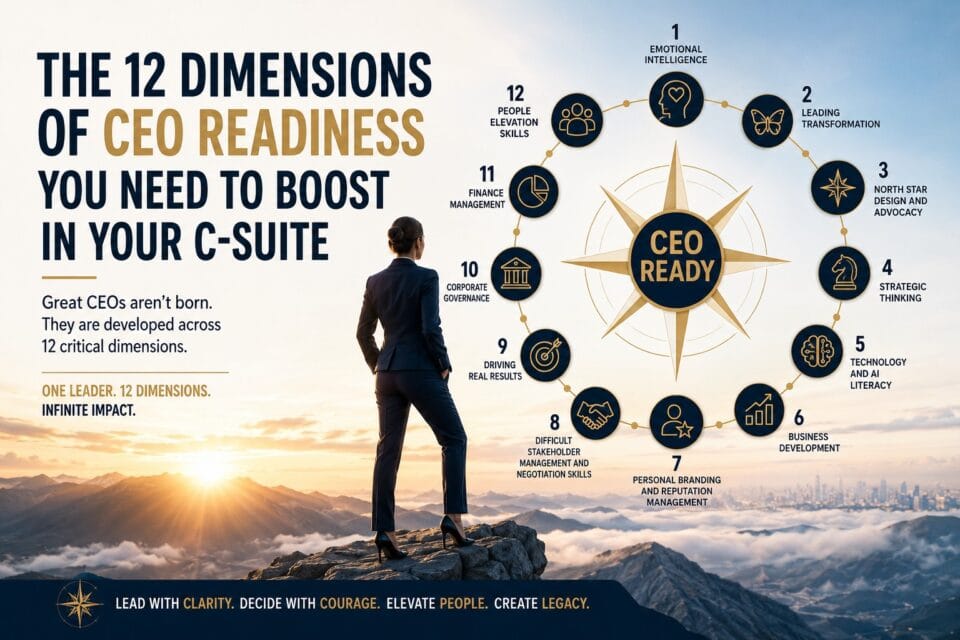
During this assessment, we look at twelve fundamental dimensions of CEO readiness that a future CEO needs to embrace and keep developing if they want to thrive in the new top leadership role.
Let me share these twelve dimensions with you – and also tell you why I consider them essential for any CEO and for any C-Suite executive striving to become the next CEO.
DIMENSION 1: EMOTIONAL INTELLIGENCE
Absolutely, fundamentally non-negotiable.
We need to do more to make sure executive teams are populated by mentally healthy, emotionally mature individuals.
This dimension includes assessing a leader’s capacity for self-reflection, healthy self-mastery, genuine cognitive, emotional, and behavioral empathy, and social intelligence – the ability to build and navigate large groups with ease.
DIMENSION 2: LEADING TRANSFORMATION
Closely connected to the first dimension, this area assesses the leader’s tolerance for uncertainty and their previous experience with transformation – whether it is personal or corporate transformation.
Can we truly lead in times of permacrisis and massive uncertainty if we haven’t navigated our own transformation processes consciously? Or if we don’t understand the fundamental difference between change management and transformation?
That’s what this dimension of CEO readiness is designed to uncover.
DIMENSION 3: NORTH STAR DESIGN AND ADVOCACY
Any company founder knows that it’s their job to define and communicate the purpose, mission, vision, values, and goals of their organization so their people know where they are heading.
Unfortunately, in corporate environments, the North Star design and advocacy muscles are often weakened by endless waiting for instructions and guidance from headquarters.
At the same time, a CEO ready for the job knows how to harness the talent, vision, and energy in their C-Suite to (re)define a North Star that makes sense for THEIR business or local market.
Such CEOs are purpose-driven, mission-articulate, and are able to describe a vision so vivid and engaging that it can uplift people.
What’s more, a CEO ready for the job knows how precious genuine company values are on the way to the North Star. Therefore, they will steward the whole C-Suite in the direction of clear values-driven leadership.
DIMENSION 4: STRATEGIC THINKING
That’s why you need a North Star – so you can define the fastest and the most effective path to get there. That’s your strategy.
The best CEOs know the value of strategic thinking. More, they carve out intentional time away from interruptions and endless meetings. During this time, they engage in big-picture thinking exercises in order to expand their aperture, observe the movements of their whole system, and decide on the best next course of action.
Leaders too busy to find time to think strategically should not be in the C-Suite in the first place.
DIMENSION 5: TECHNOLOGY AND AI LITERACY
You can’t drive AI-powered transformation if you don’t understand in your bones what AI is about.
And you can’t understand what AI can do for your company if you don’t make time to discover and test tools, to talk to people from within and outside your organization, and to discover what’s possible in the emerging hybrid human-AI era.
And no, laying off people because you needed more money to buy a few premium Copilot licenses is not an AI strategy.
DIMENSION 6: BUSINESS DEVELOPMENT
If you were to take over the sales department of your business overnight, what would you do? Where would you look first to bring money home?
A well-rounded leader understands the lifeblood of their organization – sales. They have a strategic understanding of the company’s marketing strategy and they get proactively engaged in business development and sales activities.
Every meeting a C-Suite executive has can become a sales or partnership meeting for the company.
Therefore, business development capabilities must be a fundamental part of a future CEO’s DNA.
DIMENSION 7: PERSONAL BRANDING AND REPUTATION MANAGEMENT
This dimension is particularly dear to my heart, given that I started my practice in 2010 with media training and crisis communications.
A truly ready CEO knows exactly where the official investor and media Q&A document is stored. They also know who is responsible for what in their crisis management and communications manual and what needs to be done when the crap hits the fan.
The ready CEO also understands how their efforts to build their personal brand – or lack thereof – impacts their business, not only their career.
A truly ready future CEO understands the company’s public relations strategy and is ready to respond at a minute’s notice to a nasty social media attack, crisis communication situation, or an impromptu media interview by phone. All these are skills that need to be mapped and developed so that your future CEO can hit the ground running the moment they start in their new role.
DIMENSION 8: DIFFICULT STAKEHOLDER MANAGEMENT AND NEGOTIATION SKILLS
C-Suite representatives don’t just meet with vendors. They also meet challenging stakeholders such as public officials, politicians, lobbyists, and investors who challenge their integrity and sanity – particularly when your company operates in a post-communist country.
Being able to manage complex and difficult stakeholder relations without breaking your moral bones is a tightrope walk. That’s precisely why your next CEO must be skilled at leading constructive dialogue and high-quality negotiations with even the most challenging stakeholders.
DIMENSION 9: DRIVING REAL RESULTS
This is where C-Suite executives feel most at home – in the relative safety of their own functional silos.
One of the greatest surprises for C-Suite leaders is: If my department has been delivering great results for so long, how come I haven’t been promoted to the CEO role yet?
Well, that’s because great results in your line of business are a prerequisite, but not a guarantee, of success as the next CEO..
Driving great results is only one of the twelve stands of DNA that make up a transformative CEO. And it speaks more about your past than about your future performance.
DIMENSION 10: CORPORATE GOVERNANCE
I am constantly astounded by how many C-Suite executives underestimate corporate governance in their organizations.
Quite often, executives know they’re legally liable for something – but if you ask them exactly what they are liable for, they can’t tell you.
Corporate governance is now undergoing major restructuring triggered by AI and data protection. That’s why, rather than considering it a bore, good corporate governance needs to become a vital part of any C-Suite executive’s leadership toolbox.
DIMENSION 11: FINANCE MANAGEMENT
If you can’t speak the language of money, data, facts, business cases, and return on investment, you’ll have a hard time leading from the C-Suite.
A future CEO needs to have a deep understanding of the financial landscape of their organization. Not just the CFO – everyone in the C-Suite should understand finance in order to be able to make sound decisions for the greater good of the whole organization.
DIMENSION 12: PEOPLE ELEVATION SKILLS
You may be surprised that I saved this key dimension for last. It was an intentional choice.
A leader with all eleven of the previous skill sets won’t be a good CEO if they’re not able to observe, activate, direct, and nurture talent in their executive team, C-1, and the entire organization.
Even though many people confuse managerial skills – communication, feedback, presentation skills, etc. – with leadership, this is not what leadership is about.
Real leadership is the capacity to activate the best in people and to guide it in a way that turns your North Star into reality.
This involves the capacity to navigate the messiness of human development and a strong desire to talk to people, listen to them, mentor and coach them, facilitate dialogue, and do whatever else it may take for people’s potential to expand and take off.
A great CEO is a great listener. A great CEO understands the personality profiles – and dysfunctional patterns – of the people in their C-Suite. A great CEO chooses to coach and mentor people because they know that this is how you build more than capabilities – you build a sustainable leadership legacy.
So, there you have it – the 12 dimensions of CEO readiness I evaluate when asked to develop C-Suite executives and stretch their mindset to become CEO-ready.
Is there a fundamental dimension of CEO readiness that you consider essential, but you don’t see it on my list? Please drop me a message and let’s discuss this topic in greater detail.
LET’S TALK
🏆 Did you like this post? Let me know at cristina.muntean@vornica.com or share it with your friends.
📲 Do you want to succeed in your new top leadership role? Drop me a message via WhatsApp and let’s talk: +420 776 574 574
📞 Are you ready to discuss your unique path to CEO success? Book a direct call with me and let’s talk: https://calendly.com/cristinamuntean/the-new-ceo-success-shared-vision-call.
💡Would you like more unique CEO insights and how-to advice? Follow me on LinkedIn: My newsletter The CEO Elevator® and my personal posts.